Military symbols (APP-6 / MIL-STD-2525)
Markers gain an optional sidc field. When set, maproll renders the NATO Joint Military Symbology glyph for that code — the affiliation-framed unit / equipment / installation icon that defense desks, OSINT researchers, conflict journalists, wargamers and think-tanks already work with — instead of one of the 30 generic icons.
Powered by milsymbol. Supports APP-6 B/D/E and MIL-STD-2525 C/D/E + FM 1-02.2.
Quick example
curl -sS -X POST 'https://api.maproll.io/render/map' \
  -H 'content-type: application/json' \
  --data-binary @- <<'JSON' > /tmp/app6.svg
{
  "scope": "world", "theme": "dark", "width": 1400,
  "markers": [
    { "lat": 48.5, "lon": 38.0, "sidc": "30031000001211000000", "label": "Friendly Mech Inf" },
    { "lat": 49.8, "lon": 36.0, "sidc": "30061000001211000000", "label": "Hostile Mech Inf" }
  ]
}
JSON
Or via GET URL — the SIDC goes in the icon slot (type-distinguished from named icons by being exactly 20 or 30 digits):
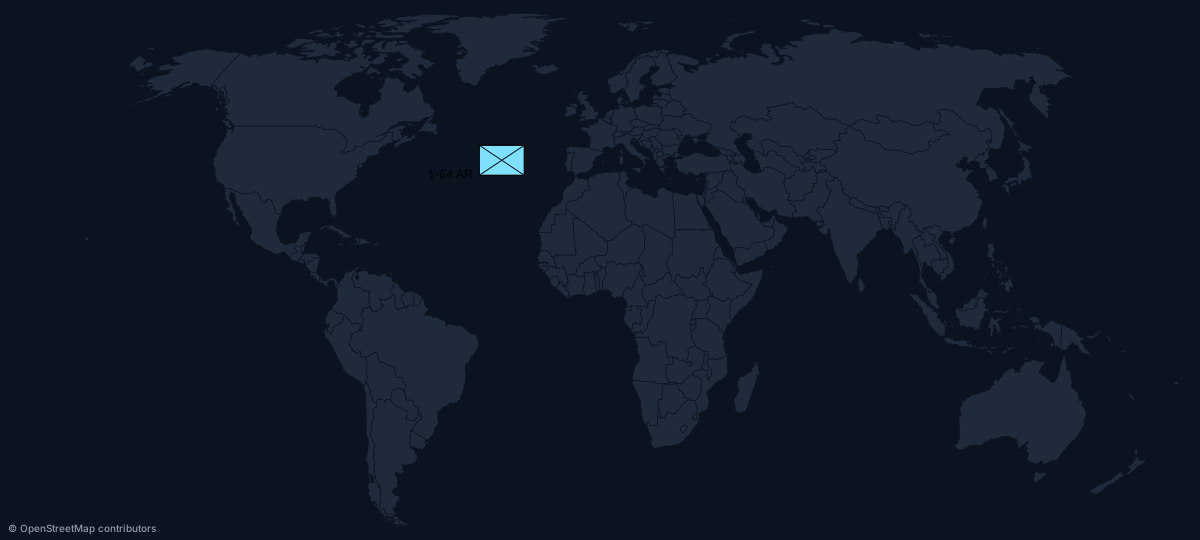
https://api.maproll.io/map.svg?scope=world&theme=dark&markers=40,-30:30031000001211000000:1-64+AR
When to use this vs icon
| If you have… | Use |
|---|---|
| A formal SIDC (your data already uses APP-6 / 2525) | sidc |
| A generic point of interest (airport, factory, fire) | icon |
| A polygon (area of interest, exclusion zone) | shapes |
| A route or flow line | routes |
icon and sidc are mutually exclusive on a single marker. Pick one.
SIDC format
A Symbol Identification Code is a digit string of length 20 (APP-6E / 2525D core) or 30 (APP-6E / 2525E full). The leading digits encode:
- Standard identity (friend / hostile / neutral / unknown / suspect / assumed friend)
- Symbol set (units / equipment / installations / activities / SIGINT / cyberspace / …)
- Status (present / anticipated / damaged / destroyed / full to capacity)
- Headquarters / task force / dummy
- Echelon / amplifier (platoon / company / battalion / brigade / …)
- Main icon + modifiers (the specific unit / equipment / activity)
maproll does not validate semantic correctness — it checks the length and lets milsymbol render. A syntactically-correct but semantically-broken SIDC lands in X-Geo-Warnings: invalid-markers:<idx>:sidc and the render still returns 200.
If you don't have a SIDC builder, the milsymbol library and the APP-6E specification document the digit-position semantics.
Marker fields when using sidc
| Field | Effect |
|---|---|
lat, lon | Position on the map. Same as icon markers. |
sidc | Required (instead of icon). 20 or 30 digits. |
size | Default 30 px (vs 17 for icon markers). 1–200. |
rotation | Maps to milsymbol's direction option (-360..360). A rotation of 0 is passed through as no direction at all. |
label | With no labelPosition, rendered as the milsymbol uniqueDesignation amplifier — top-right field of the frame on unit symbols. Max 64 chars. |
color | Ignored when sidc is set. Affiliation drives colour per APP-6 / 2525. |
labelPosition | Opts the label out of the amplifier and into a plain caption beside the symbol (top, bottom, left, right), suppressing uniqueDesignation so the text isn't drawn twice. Omit it to keep the amplifier. |
Limits and behaviour
- Up to 1000 markers per request (the existing
MAX_MARKERScap — SIDC and icon markers share the budget). - Length-only schema check. On
POST, a SIDC that isn't exactly 20 or 30 digits →400 invalid_sidc;iconandsidcon the same marker →400 marker can have either icon or sidc, not both. On the URL path a wrong-length digit string is not an error — it falls through to the icon slot's unknown-name handling, rendering a ⚠ placeholder withX-Geo-Warnings: invalid-markers:<idx>:unknown-icon:<value>and a 200. - Runtime SIDC failure (semantic) → marker skipped +
X-Geo-Warnings: invalid-markers:<idx>:sidc+ render returns 200. - Marker outside the projection's visible domain → silently skipped (same as icon markers).
- Cache:
sidcis part of the per-marker hash, so changing it produces a new ETag. SIDC and icon variants at the same coord cache to different entries.
Reserved (not exposed in v1)
milsymbol supports many more options that aren't yet surfaced through the API. Mention if you need one:
quantity,staffComments,additionalInformation,higherFormationdtg(date-time group),location,combatEffectivenessfilled/unfilled, explicitframeColor/monoColoroverrides- Tactical graphics / control measures (boundaries, attack axes, phase lines) — these are polyline/polygon symbology and will arrive later as an extension of
shapes.
Related
- Markers (icon library) — the 30-icon path
- Custom shapes — polygons / polylines / styled points
- Routes — flows between two endpoints
POST /render/map— full JSON body schema